
Browns Morpheme Chart
Browns Morpheme Chart - Web brown (1973) brown produced the definitive study of morphological development in english. Reoccurrences of a word for emphasis compound words (two or more free morphemes) proper. Web the stages provide a framework within which to understand and predict the path that normal expressive language development usually takes, in terms of morphology and syntax (defined in the full article). Click the card to flip 👆. Brown's stages i, ii, iii, iv, v. In 1973, a researcher by the name of roger brown isolated 14 morphemes that appear early in child language. Web brown's stages (brown's morphemes) i to iv. I made this with clear examples to help you develop goals for young speech clients. Each stage has an age range (in months), an mlu range, structure types, and examples. Young children who are in brown's stage one range in age from 12 to 26 months. On tree, birdie on head. Web breakdown of brown's stages and grammatical morphemes with definitions and example utterances. Web preschool morphology chart brown’s rules for counting morphemes rule example count as 1 morpheme: Sara’s car or her car, it is difficult to determine an exact age of acquisition. He used a methodology that was similar to cazden’s to analyze the development of 14 grammatical morphemes. Web known as “brown’s stages.” roger brown identified these stages to help understand and predict typical expressive language development in children. • not to be confused with gerunds or adjectives. Web brown offers 14 grammatical morphemes to utilize in the analysis of morphological and syntactic language. Web roger brown identified these stages to help understand and predict typical expressive language development in children. Click the card to flip 👆. Let's outline brown's grammatical morphemes and consider an example of a child utterance to solidify this concept. Web breakdown of brown's stages and grammatical morphemes with definitions and example utterances. He determined the children’s order of morpheme acquisition by using the percentage of obligatory morphemes supplied by the children. Brown's stages i, ii, iii, iv, v. Web *all grammatical morphemes. Web brown's research team documented children's increasing use of 14 morphemes by reporting the percent inclusion of each grammatical morpheme in obligatory contexts. Web a pretty visual of brown's stages of grammatical morphemes to use as a general guide. Web known as “brown’s stages.” roger brown identified these stages to help understand and predict typical expressive language development in children.. Sara’s car or her car, it is difficult to determine an exact age of acquisition. In this wiki, we’re going to take a closer look at what brown’s morphemes are. Web breakdown of brown's stages and grammatical morphemes with definitions and example utterances. Web you can use this chart to understand the development of a child’s language skills. Web brown’s. Brown's stages i, ii, iii, iv, v. On tree, birdie on head. In this wiki, we’re going to take a closer look at what brown’s morphemes are. I made this with clear examples to help you develop goals for young speech clients. The present progressive is formed by combining the verb to be with the present participle. Web a pretty visual of brown's stages of grammatical morphemes to use as a general guide. Web *all grammatical morphemes are typically acquired by about 4 years of age. Brown's stages i, ii, iii, iv, v. Web breakdown of brown's stages and grammatical morphemes with definitions and example utterances. • not to be confused with gerunds or adjectives. Web brown's stages (brown's morphemes) i to iv. Web brown’s stages, also known as brown’s morphemes, refer to a sequence of 14 grammatical structures that children acquiring english typically master in a predictable order between the ages of 15 months to 4 years old. Web brown's research team documented children's increasing use of 14 morphemes by reporting the percent inclusion. Web known as “brown’s stages.” roger brown identified these stages to help understand and predict typical expressive language development in children. He used a methodology that was similar to cazden’s to analyze the development of 14 grammatical morphemes. Web roger brown identified these stages to help understand and predict typical expressive language development in children. On tree, birdie on head.. Reoccurrences of a word for emphasis compound words (two or more free morphemes) proper. The present progressive is formed by combining the verb to be with the present participle. Web brown’s stages, also known as brown’s morphemes, refer to a sequence of 14 grammatical structures that children acquiring english typically master in a predictable order between the ages of 15. Web the stages provide a framework within which to understand and predict the path that normal expressive language development usually takes, in terms of morphology and syntax (defined in the full article). Web a printable chart of brown's morphemes perfect for easy reference in a preschool, daycare, or school setting. Web a pretty visual of brown's stages of grammatical morphemes. Web breakdown of brown's stages and grammatical morphemes with definitions and example utterances. Web brown’s morphemes, also sometimes referred to as brown’s stages, are used by speech therapists and speech pathologists when they analyse how a child uses language, and how their ability to use it is developing. On tree, birdie on head. Web brown’s stages, also known as brown’s. Web brown's research team documented children's increasing use of 14 morphemes by reporting the percent inclusion of each grammatical morpheme in obligatory contexts. Web known as “brown’s stages.” roger brown identified these stages to help understand and predict typical expressive language development in children. In this wiki, we’re going to take a closer look at what brown’s morphemes are. The present progressive is formed by combining the verb to be with the present participle. Web roger brown identified these stages to help understand and predict typical expressive language development in children. Let's outline brown's grammatical morphemes and consider an example of a child utterance to solidify this concept. Web brown’s stages, also known as brown’s morphemes, refer to a sequence of 14 grammatical structures that children acquiring english typically master in a predictable order between the ages of 15 months to 4 years old. Web brown's stages (brown's morphemes) i to iv. In 1973, a researcher by the name of roger brown isolated 14 morphemes that appear early in child language. Brown's stages i, ii, iii, iv, v. As children's mlum increases their capacity to learn and use grammatical structures of greater complexity increases. Web you can use this chart to understand the development of a child’s language skills. Web brown (1973) brown produced the definitive study of morphological development in english. Click the card to flip 👆. Each stage has an age range (in months), an mlu range, structure types, and examples. • not to be confused with gerunds or adjectives.Preschool Morphology Browns Morpheme Stages.pdf Google Drive

Brown's 14 morphemes Download Table

Use of Brown's 14 Grammatical Morphemes by Bilingual Hispanic

Chart Morpheme Types, Examples, Age of Mastery Speech Therapy

Brown's Stages of Morphological Development

Brown's 14 Grammatical Morphemes Chart

Brown's Grammatical Morphemes Chart
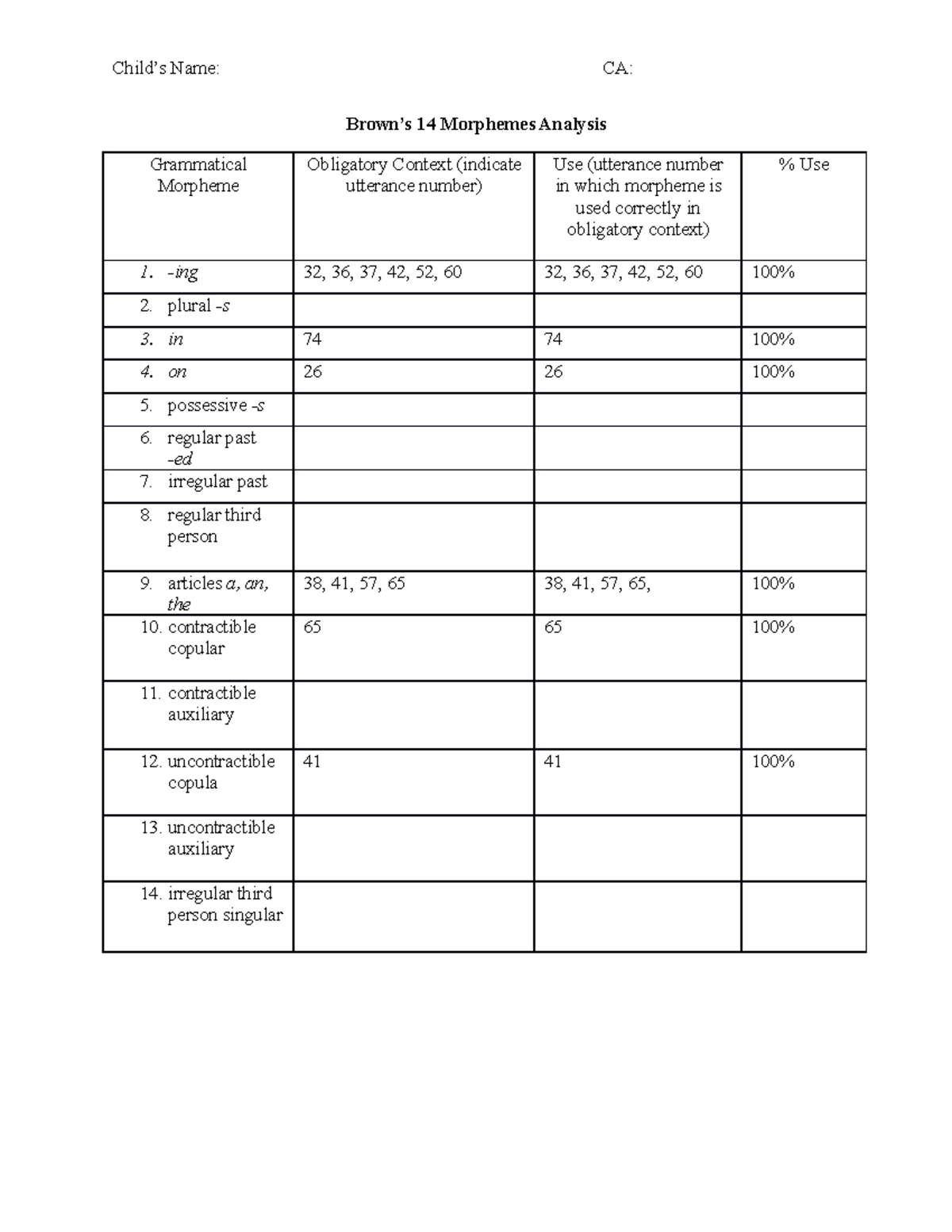
LSA Morphology Brown's 14 Grammatical Morphemes Analysis Brown’s 14

Brown's 14 Grammatical Morphemes Chart Printable Templates Free
Brown's 14 Grammatical Morphemes Chart
He Determined The Children’s Order Of Morpheme Acquisition By Using The Percentage Of Obligatory Morphemes Supplied By The Children.
Reoccurrences Of A Word For Emphasis Compound Words (Two Or More Free Morphemes) Proper.
Sara’s Car Or Her Car, It Is Difficult To Determine An Exact Age Of Acquisition.
Use For Studying, Wall Art, Etc.
Related Post:
